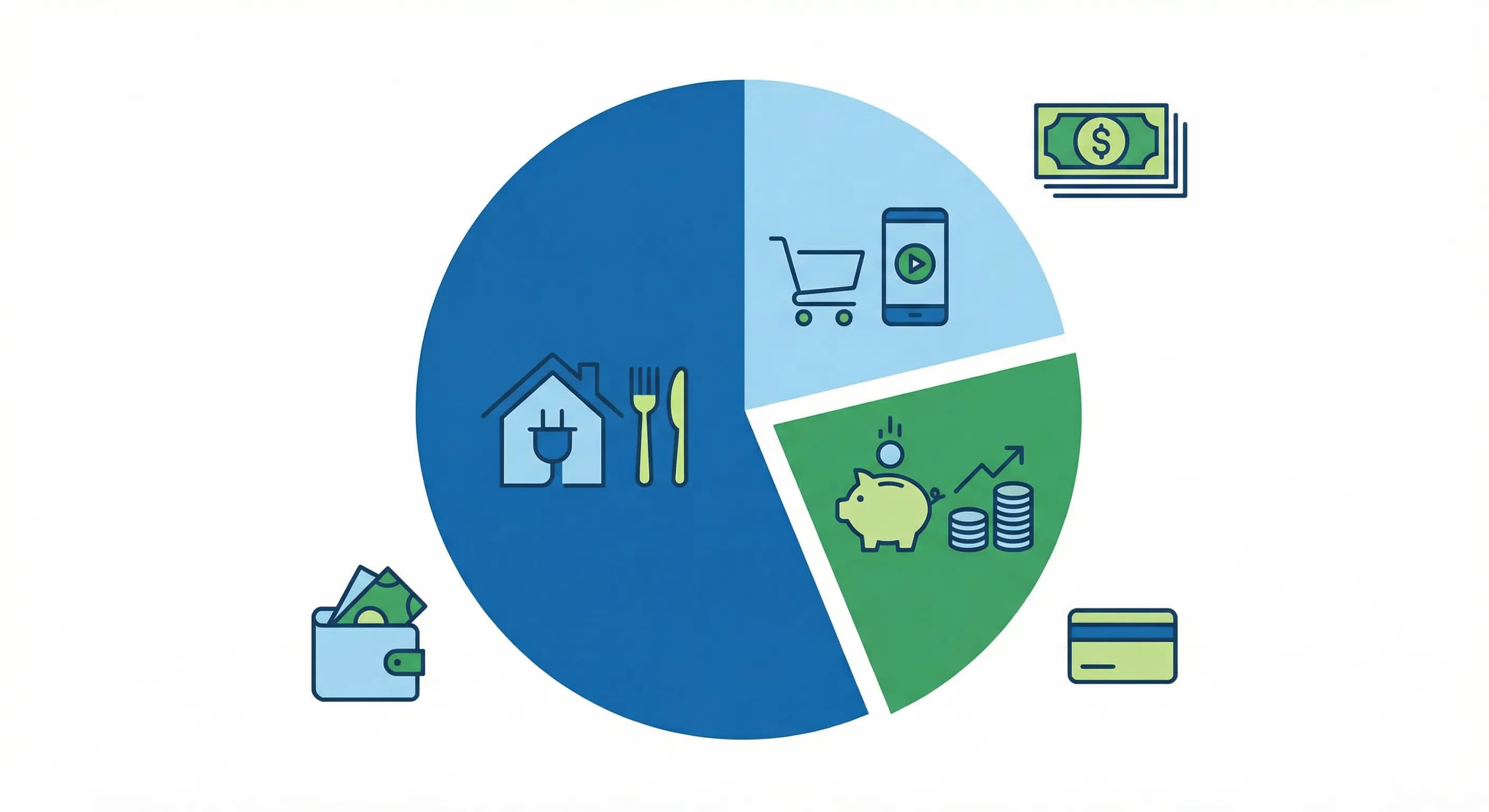
50/30/20 Budget Rule Calculator: How to Budget Your Paycheck
50/30/20 Budget Rule Calculator: How to Budget Your Paycheck The 50/30/20 budget rule divides your after-tax income into three categories: 50% for needs, 30% for wants, and 20% for savings and debt repayment. If your take-home pay is $4,000 per month, that means $2,000 for necessities, $1,200 for discretionary spending, and $800 for financial goals. Consider a typical case: tracking every dollar of a $4,200 monthly take-home paycheck for six months using this rule. Before adopting 50/30/20, monthly savings ran barely $150 with no real plan. Within the first year, sticking to the 20% savings target built a $5,400 emergency fund and paid off $3,800 in credit card debt. Use our Budget Calculator(/finance/budget-calculator) to instantly see your personalized 50/30/20 breakdown based on your income. !50/30/20 budget rule breakdown showing needs, wants, and savings allocation on $5,000 monthly income with category examples(/images/blog/50-30-20-budget-breakdown.svg) What Is the 50/30/20 Budget Rule? The 50/30/20 rule...

Savings Goal Calculator: How Much to Save Each Month
Savings Goal Calculator: How Much to Save Each Month To reach any savings goal, divide your target amount by the number of months until your deadline. If you need $10,000 for a down payment in 2 years, you need to save $417 per month. Factor in interest from a high-yield savings account, and you might reach your goal faster. Last year I set a goal to save $18,000 for a home down payment in 18 months. By parking my money in a 4.5% APY high-yield savings account and automating $950 monthly transfers on payday, I actually hit my target two months early -- the $627 in interest earnings made the difference. Breaking a big number into a concrete monthly amount turned an intimidating goal into something I could track and control. Use our Savings Goal Calculator(/finance/savings-goal-calculator) to create a personalized savings plan with interest calculations included. !Savings growth timeline showing...
US Tipping Etiquette Guide: Who to Tip, How Much, and When
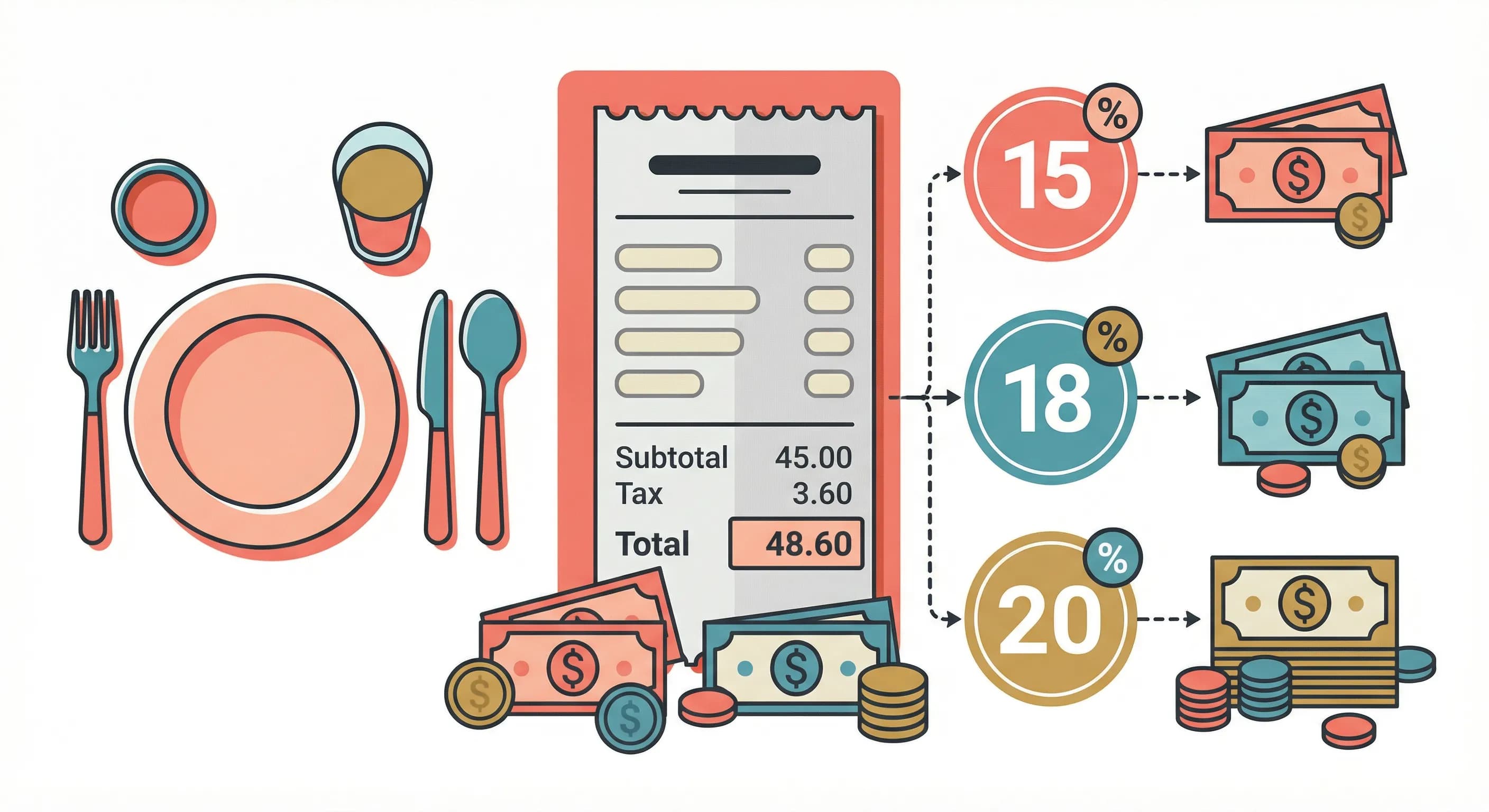
How to Calculate Tips: Complete Guide for US Restaurants To calculate a tip, multiply your bill by the tip percentage as a decimal. For a $50 bill with a 20% tip: $50 × 0.20 = $10 tip, making your total $60. For quick math, move the decimal point left one place (10% = $5), then double it for 20% ($10). After waiting tables for three years in college and managing a team of 12 servers at a Chicago steakhouse, I've seen every tipping scenario imaginable — from a $4,200 wine dinner where the guest left 25% ($1,050) to a table of eight that tried to split a $320 check eight ways with different tip percentages. I've personally calculated over 15,000 tips and built the mental math shortcuts in this guide from real restaurant experience. These methods are the same ones I trained new servers to use when verifying their end-of-night...