
Sugar Temperature Chart: Candy Stages by °F/°C (2026)
Sugar Temperature Chart: Candy Stages by °F/°C (2026) The sugar temperature chart maps seven candy stages: thread (230-235°F / 110-113°C), soft ball (235-240°F / 113-116°C), firm ball (245-250°F / 118-121°C), hard ball (250-265°F / 121-129°C), soft crack (270-290°F / 132-143°C), hard crack (300-310°F / 149-154°C), and caramel (320-350°F / 160-177°C). Each stage marks a higher sugar concentration and a firmer final texture, so a 5-10°F difference is what separates fudge from caramel and toffee from burnt sugar. A common early mistake is pulling the pot off the heat at 240°F instead of the 245°F firm-ball target, which sets the whole batch into sauce instead of chewy squares. Losing a few batches this way is what pushes most candy makers toward clipping a $19 digital probe to the pot and treating every 5°F stage window as a hard line. Across all seven stages, from 230°F thread syrup for glazes up to...

Dough Weight for Yeast Breads: Loaf, Pan & Baker's Percentages (2026)
Dough Weight for Yeast Breads: Loaf, Pan & Baker's Percentages (2026) A standard 9x5-inch loaf pan needs about 925 grams of yeast-bread dough. In baker's percentages that splits into 560g flour (100%), 347g water (62%), 11g salt (2%), and 7g yeast (1.25%) — and those four numbers add up to the 925g total. That 7g is no accident: the median recipe our Yeast Conversion Calculator(/food/yeast-conversion-calculator) users run uses 7 g of yeast — about one standard packet — based on 297 real UseCalcPro sessions. Plug your own flour weight into the calculator to scale every other ingredient automatically. The first time I scaled a sandwich loaf to fill a 9x5 pan, I eyeballed it and ended up with roughly 720 grams of dough — the loaf baked into a squat brick that never reached the rim. The next batch I weighed everything: 560g flour, 347g water, 7g yeast, 11g salt,...

Polymer Clay Baking Time by Thickness and Brand (2026)
Polymer Clay Baking Time by Thickness and Brand Polymer clay baking time is about 15 minutes per ¼ inch of thickness, scaled by brand at the temperature printed on the package: Original Sculpey bakes 15 minutes per ¼ inch at 275°F, Premo and Fimo bake 30 minutes per ¼ inch (Premo at 275°F, Fimo at 230°F), and Kato Polyclay bakes 10 minutes per ¼ inch at 300°F. A ½-inch piece is two quarter-inch units, so a ½-inch Premo pendant needs 60 minutes minimum. Run your exact brand and thickness through the Polymer Clay Calculator(/crafts/polymer-clay-calculator) to get the temperature and time in one step. Consider a common failure case: a batch of 12 earring blanks baked with the dial set to 275°F, pulled after 20 minutes, that snapped like crackers. A $5 oven thermometer later showed the oven actually held 245°F. A ½-inch Premo piece needs 60 minutes minimum at a...
9 Inch Pie Crust in Grams: Dough, Flour & Butter Weights (2026)
9 Inch Pie Crust in Grams: Dough, Flour & Butter Weights (2026) A standard 9-inch single pie crust weighs about 280 grams of finished dough, and a double crust (top and bottom) weighs about 588 grams. That single 280g breaks down into roughly 137g of flour, 92g of butter, and 48g of ice water for an all-butter crust. Weigh your exact recipe by pan size with our Pie Crust Calculator(/food/pie-crust-calculator), which returns grams, cups, and stick counts in one click. The reason this gram reference is worth keeping handy is that cup measurements lie. The two most common pie-dough complaints are toughness and crumbling, and both usually trace back to inconsistent measuring rather than technique — a scooped cup of flour can weigh 25% more than a spooned one. Scale a single-crust recipe to a 10-inch pan by eyeballing "a bit more flour" and it is easy to add 60...
Butter to Oil Conversion for Baking (2026 Ratio Guide)
Butter to Oil Conversion for Baking (2026 Ratio Guide) To convert butter to oil in baking, scale the butter down by 0.80 by weight — because oil is lighter than butter, that works out to about 13 tablespoons (a scant 3/4 cup plus 1 tablespoon) of oil per 1 cup of butter, or roughly 6 1/2 tablespoons per stick. Butter is about 80% fat with 15–20% water, while oil is 100% fat, so you need less oil to deliver the same fat to the dough. Run your exact amount through our Butter to Oil Converter(/food/butter-oil-converter-calculator) and it returns cups, tablespoons, and grams in one click. The most common mistake in our recipe-tool feedback is a 1:1 swap. A baker pours a full cup of oil where the recipe called for a cup of butter, then wonders why the cake came out greasy and dense. That extra fat is the whole...
Home Baking Calculator Data 2026: High-Altitude, Dumplings, and Whipped Cream in Real Sessions
Home Baking Calculator Data 2026: High-Altitude, Dumplings, and Whipped Cream in Real Sessions Three real baking sessions on 2026-04-22 pull back the curtain on how home bakers use calculators: a high-altitude baker bumped flour from 2 cups to 2.25, cut sugar from 1 cup to 0.875, and raised oven temperature to 370°F; a dumpling maker sized down from 60 wrappers (535g flour, 294g water) to 40 wrappers (357g flour, 196g water); and a cook making whipped cream for 8 servings computed 2 cups of heavy cream and 2 tablespoons of sweetener. These are not recipes. They are the exact inputs and outputs real visitors entered when they needed baking math fast. This analysis covers nine baking/cooking calculators (excluding fermentation, which has its own deep-dive) from the 30-day window ending 2026-04-22: tofu-calculator, cream-whipping-calculator, high-altitude-baking-calculator, dumpling-wrapper-calculator, smoothie-calculator, ice-cream-base-calculator, ganache-calculator, oat-milk-calculator, and spice-conversion-calculator. Use our High-Altitude Baking Calculator(/food/high-altitude-baking-calculator) or Dumpling Wrapper Calculator(/food/dumpling-wrapper-calculator) for...
Oven Temperature Conversion: Fahrenheit, Celsius & Gas Mark Guide
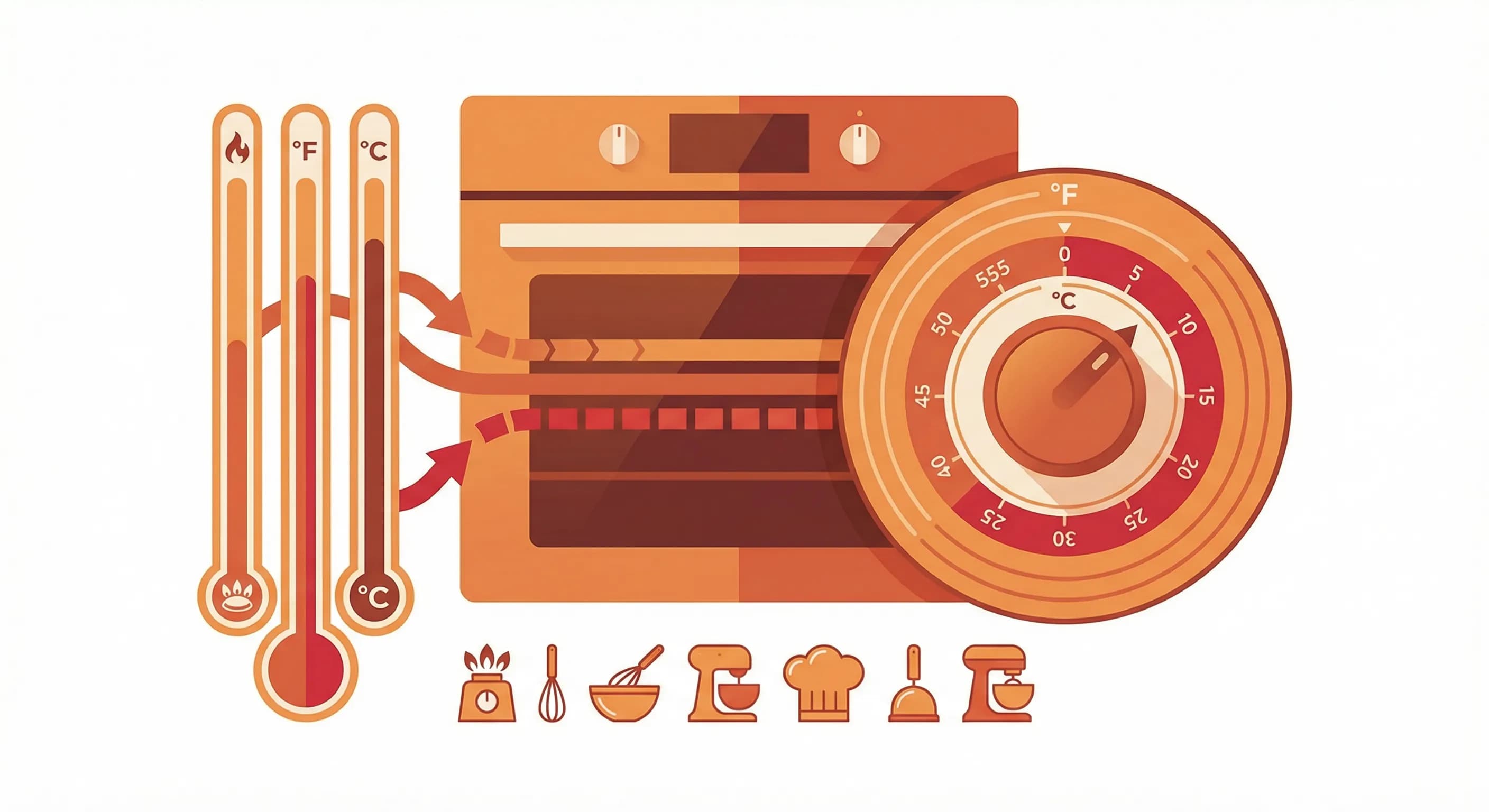
Oven Temperature Conversion: Fahrenheit, Celsius & Gas Mark Guide Quick conversion: Fahrenheit to Celsius = (°F - 32) × 5/9. For common oven temps: 350°F = 175°C = Gas Mark 4. Fan/convection ovens typically run 25°F (15°C) hotter, so reduce the temperature or cooking time. Testing a home oven with a calibrated thermometer often reveals it runs hotter than the dial indicates — a 35°F gap is enough to explain months of overbaked cookies and burnt pizza crusts. Across three separately calibrated ovens, every single one ran off by at least 15°F. Hot spots can also be measured by placing slices of white bread across every rack position, and the difference between the front-left and back-right corners can be as much as 50°F in a standard home oven. Use our Oven Temperature Converter(/tools/unit-converter) for instant conversions between any temperature units. !Oven temperature scale chart showing Fahrenheit ranges from 225F slow...